Friday, March 07, 2008

1,000 True Fans

A creator, such as an artist, musician, photographer, craftsperson, performer, animator, designer, videomaker, or author - in other words, anyone producing works of art - needs to acquire only 1,000 True Fans to make a living.


From a thought provoking article by Kevin Kelly about how to make it as an artist in whatever age we're in now, the one after the Age of Mechanical Reproduction.

Thanks to the Internet, there can now be far more idiosyncratic artists in all disciplines who are able to make an honest living, with high status within a certain subculture. The corollary to this may be that after a while there will be fewer expensive blockbuster movies and platinum albums.

And while I haven't been a "true fan" of Trent Reznor, the first music he's created after being free of Interscope is, by far, his most compelling. I encourage you to download it. For free.

Saturday, March 01, 2008

Si usted no entiende la etiqueta...

Si usted no entiende la etiqueta....


Really funny text below the Caution Statement on this label for Clorox Disinfecting Kitchen Cleaner. Everything that appears on the label in English also appears in Spanish, so I'm not sure why they'd need to single out their Spanish speaking consumers to tell them what they should do if they couldn't understand it.

Tuesday, February 26, 2008

Torschlusspanik

The Advantages of Closing a Few Doors is a nice take by John Tierney on the power of letting go -- accepting realistic limits on how many possible futures you can entertain.

Xiang Yu was a Chinese general in the third century B.C. who took his troops across the Yangtze River into enemy territory and performed an experiment in decision making. He crushed his troops’ cooking pots and burned their ships.
He explained this was to focus them on moving forward — a motivational speech that was not appreciated by many of the soldiers watching their retreat option go up in flames. But General Xiang Yu would be vindicated, both on the battlefield and in the annals of social science research.


And thanks to Time putting some of its archives online, I can provide the name for the trope of the closing door: Torschlusspanik, as felt in East Germany, 1961:

Last week a curious and serious malady was affecting Communist East Germany and reaching almost epidemic proportions. The name of the disease was Torschlusspanik, which literally means "fear of gate closing." Everything East German leaders did to shut off the flow of refugees to the West seemed, instead, to spur it on.


So the fear of a closing gate spurs people to finally take the hard path to the desired outcome.


There seems to be a lot of Torschlusspanik in the air these days.

unreleased Marumari EP

Has been available from the source himself for quite a while now, here. It is quite good, as usual. Simple, blissful, wordless electronica. I would have paid money for it...

Thursday, February 14, 2008

Name Mangler

New version of the file renaming utility formerly known as File List. I have used several such utilities and this one's the best. Powerful regexes and conditionals, though I still manage to find things I can't make it do. Probably my fault. New version Leopard-only.

Wednesday, February 06, 2008

more tropes

Tropes of the Times -- words which occur more frequently in the NY Times than anywhere else.


more?

Tuesday, February 05, 2008

Biometric database

Did you see the story about the gov't's biometric database? Storin' your iris patterns, etc.


What will be convenient will be when the gov't underwrites the cost of the program by renting access to the database, because it will mean I can buy a Coke just by winking at the Coke machine.

Wednesday, January 30, 2008

À la recherche du temps perdu

BBC reporting Electrical stimulation of areas deep within the brain could improve memory, early research suggests.

Fairly poignant stuff. Cyberpunk meets Proust. When it's reported in the NY Times, I hope they pull out a reference to madeleines from their trope-bucket.

Sunday, January 20, 2008

Phantom Orchard


Phantom Orchard is an album by Zeena Parkins and Ikue Mori which is growing on me greatly. I truly possess no technical musical vocabulary to bring to bear to explain what about this complicated noisescape is so arresting; all I can say is it feels uncomfortable and restless, but somehow compels the listener (me, at least) to pay attention -- something missing from most music of this type.

Wednesday, January 09, 2008

NetNewsWire now free

I've been using the previously-free "light" version of this RSS reader for a while; now the full version is free too.

Tuesday, January 01, 2008

windshields of the midwest - week 52/week1


2007-12-NorthDakota-GrainElevator.jpg
North Dakota

2008-01-winter-driving.jpg
Indiana

2008-01-winter-driving-2.jpg
One of those other states that begins with an I.

Friday, December 21, 2007

Happy Solstice

Merry Christmas
solstice.jpg
Two shots outside my office window near the end of the year.

Tuesday, December 04, 2007

Software I Use


I hereby present my list of Geek Force Multipliers.... with URLs now:


Effort Reducers


  • LaunchBar — CLI for the GUI. A revolution away from pointing and clicking.

  • DragThing — the opposite of LaunchBar; still better than the Dock.

  • Path Finder — still better than the Finder. Gets routine things done more easily, and copy operations are faster.

  • Typeit4me — now I can type 80 wpm.

  • Hazel — rule based refiling to keep up with the torrent. For instance, anything on the desktop with "receipt" in the file name gets moved to the receipts folder.

  • MenuCalendarClock — I use this just because it lets me see the date in the menubar in yyyy-mm-dd format, and I don't suppose I need to say why that's so great.


Outboard Brains


  • OmniOutliner — for a while every project had an outline; now I use it mostly for structured writing.

  • TaskPaper — for the daily hit list.

  • VoodooPad — like an extra large messenger bag, it's simple and versatile. Requires a change in mindset to get the most use out of it. Hoping it gains all of taskpaper's abilities over time.


System Utilities


  • Cocktail — once every 6 months or so. Good for clearing out font caches, etc.

  • Growl — good for use with hazel so you know what your robot is doing.


By the way, a couple of these are on sale this month only through MacSanta.

Thursday, November 29, 2007

Buyn'large

Looks like Pixar's getting their mojo back: www.buynlarge.com. Is there a word for this kind of bleedover-from-a-fictional-universe website? There should be.

Monday, October 29, 2007

Leopard

John Siracusa's Leopard review for Ars Technica is, as usual, the "Sunday New York Times" of Macintosh reporting. Highly recommended if you're looking for thorough and forward-looking GUI-to-kernel coverage.

Here's the bit that's most intriguing for folks with lots of data locked up in Adobe or Microsoft formats:
Yep, it's (finally) the end of the line for Carbon GUI applications in Mac OS X. Oh, sure, they'll be around for years and years to come, but the lack of 64-bit support is a long-term death sentence.

I can only dream about what Photoshop or Illustrator would be like if they were rewritten in Cocoa...

Friday, October 26, 2007

TaskPaper

TaskPaper is actually a lot more useful than it looks like it might be at first glance. Zero bloat. "Fiddle-proof" as Merlin Mann says....

and it's at least a little bit AppleScriptable. I'm sure Jesse will be working on making that more robust... would be nice to have a QuickSilver-like method of text entry.

Monday, October 01, 2007

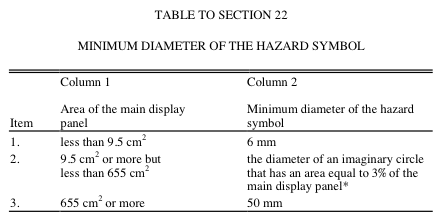
Canadian Signal Word Type Height Calculator

If you're in the business of designing packaging for Consumer Packaged Goods to be sold in Canada, you may have run across the amazingly complicated formula for calculating the size of the word "Caution" as it sits at the bottom of the package, warning the consumer not to drink the Drano, or what have you. The corresponding icons for "poisonous," "contents under pressure," etc. are quite punk rock, I will have to upload those later.

hazard.gif

So, this is the kind of thing you only have to do twice before it's safer and easier to offload the entire calculation off to the computer.

#! usr/bin/perl
# a formula used to calculate size of "signal word" for Cdn cautionary copy.
# Find diameter of a circle with an area equal to 3% of the PDP.
# That's how big any required symbol needs to be.
# The signal word then has to be 1/4 that size.

use Math::Complex;
use constant PI => 4 * atan2(1, 1);
print "enter the X dimension of your PDP in centimeters\n";
my $xDim = (<\STDIN\>);
print "enter the y dimension of your PDP in centimeters\n";
my $yDim = (<\STDIN\>);
my $PDPArea = $xDim * $yDim;
my $SignalWordHeight = (sqrt(($PDPArea * .03)/PI))/2;

printf "the area of the principal display panel is %.3f cm square, and the signal word should be at least %.3f cm high.\n", $PDPArea, $SignalWordHeight;

Update: Had to escape "STDIN" with backslashes for Blogger. Remove before use.

Saturday, September 29, 2007

Visualization

In which I start out talking about decision trees, and end up talking about shelf sets.

Matt Neuburg has an interesting writeup at Tidbits of a decision making tool called Flying Logic. The program creates "intelligent" decision trees that provide visual feedback as to how to navigate the complex web of dependencies required in order to get to a goal.

Yes, you can do this with a whiteboard (or Omnigraffle), but those don't let you offload logic out of your head.

This is a tool that's probably only worth checking out for major initiatives, but more broadly, the power of visualization in aiding group decision-making can't be overstated. Without visual reference, planning meetings are essentially Socratic dialogs, which is unnecessarily hard work.

Even in the world of brand design, I am often sitting in a meeting talking about "the chosen design" and what needs to happen to it... without any visual reference. Looking around the table, you can see everyone's eyes focussing off in the middle distance as we recall what that design looked like. More unnecessarily hard work.

Think ahead about what needs to be in your library of visual reference material, and keep it at hand in your team's public discussion areas. For CPG design, this means comprehensive shelf sets, and reference for visual equity elements and physical materials. Don't have your meetings in conference rooms, you'll just have to bring your stuff there, and that's too much work, so you won't.

Sunday, September 23, 2007

About a certain type of article which seems to be typical of the New Yorker

Simulacra in the high culture bazaar.... (via BoingBoing)

There was an interesting article by James Surowiecki in the New Yorker this week about fashion design knockoffs, and the unacknowledged link in the chain of commerce which they play:

The paradox stems from the basic dilemma that underpins the economics of fashion: for the industry to keep growing, customers must like this year’s designs, but they must also become dissatisfied with them, so that they’ll buy next year’s.

It seems the real depends upon the simulacra in order to exist, or at least to have value.

There have been many other articles about the phenomenon of the simulacra over the past few years in the New Yorker. Here's a few off the top of my head:

  • Calvin Trillin's claim that white wine served at room temperature tastes just like red wine if you close your eyes (I think Cal should stick to food writing).
  • The story I blogged earlier about Argentinian sunflower-seed oil etc. being labeled as extra-virgin Italian olive oil.
  • Last week's incredible story about Joyce Hatto, the greatest pianist who never was, and her Svengali-like husband, who assembled hundreds of Joyce Hatto CDs out of bits and bobs of other recordings, and turned her into a star, until the hoax was discovered. I liked the bit at the beginning about the cottage industry of recordings issued under false names.
  • The story the week before that about the hard-working counterfeiter of bottles of wine reputed to have belonged to Thomas Jefferson, which sold to collectors for hundreds of thousands of dollars. Robert Parker was a fan.

Each of these articles takes as their subject a culturally freighted pleasure which forms one of the cornerstones of their target demographic's highbrow, luxury lifestyle: gourmet food, wine auctions, classical music, haute couture. In each case, received wisdom about the hierarchy of the Good is tested: blindfolded, could you tell white wine from red? How can critics praise the same recordings when attributed to Joyce Hatto which they dismissed when presented under their true performer's name? If a blind stranger came to dinner and you served him dog food, how much trouble would you be in when he turned out to be Wotan?

I guess part of what this supports is the idea that with the New Yorker you get the unvarnished truth, including cultural metacriticism.

So what is clearly needed to complete these categories of counterfeitings is a story about a literary fiction. It's surprising the Raymond Carver - Gordon Lish authorship dispute never made it to their pages.

But yes: in this aisle of culture, the New Yorker is a producer, not a critic.