Fairly poignant stuff. Cyberpunk meets Proust. When it's reported in the NY Times, I hope they pull out a reference to madeleines from their trope-bucket.
Wednesday, January 30, 2008
À la recherche du temps perdu
BBC reporting Electrical stimulation of areas deep within the brain could improve memory, early research suggests.


Sunday, January 20, 2008
Phantom Orchard

Wednesday, January 09, 2008
NetNewsWire now free
I've been using the previously-free "light" version of this RSS reader for a while; now the full version is free too.
Tuesday, January 01, 2008
windshields of the midwest - week 52/week1

North Dakota

Indiana

One of those other states that begins with an I.
Friday, December 21, 2007


Tuesday, December 04, 2007
Software I Use
I hereby present my list of Geek Force Multipliers.... with URLs now:
Effort Reducers
- LaunchBar — CLI for the GUI. A revolution away from pointing and clicking.
- DragThing — the opposite of LaunchBar; still better than the Dock.
- Path Finder — still better than the Finder. Gets routine things done more easily, and copy operations are faster.
- Typeit4me — now I can type 80 wpm.
- Hazel — rule based refiling to keep up with the torrent. For instance, anything on the desktop with "receipt" in the file name gets moved to the receipts folder.
- MenuCalendarClock — I use this just because it lets me see the date in the menubar in yyyy-mm-dd format, and I don't suppose I need to say why that's so great.
Outboard Brains
- OmniOutliner — for a while every project had an outline; now I use it mostly for structured writing.
- TaskPaper — for the daily hit list.
- VoodooPad — like an extra large messenger bag, it's simple and versatile. Requires a change in mindset to get the most use out of it. Hoping it gains all of taskpaper's abilities over time.
System Utilities
- Cocktail — once every 6 months or so. Good for clearing out font caches, etc.
- Growl — good for use with hazel so you know what your robot is doing.
By the way, a couple of these are on sale this month only through MacSanta.
Thursday, November 29, 2007
Buyn'large
Looks like Pixar's getting their mojo back: www.buynlarge.com. Is there a word for this kind of bleedover-from-a-fictional-universe website? There should be.
Monday, October 29, 2007
Leopard
John Siracusa's Leopard review for Ars Technica is, as usual, the "Sunday New York Times" of Macintosh reporting. Highly recommended if you're looking for thorough and forward-looking GUI-to-kernel coverage.Here's the bit that's most intriguing for folks with lots of data locked up in Adobe or Microsoft formats:
Yep, it's (finally) the end of the line for Carbon GUI applications in Mac OS X. Oh, sure, they'll be around for years and years to come, but the lack of 64-bit support is a long-term death sentence.
I can only dream about what Photoshop or Illustrator would be like if they were rewritten in Cocoa...
Friday, October 26, 2007
TaskPaper
TaskPaper is actually a lot more useful than it looks like it might be at first glance. Zero bloat. "Fiddle-proof" as Merlin Mann says....
and it's at least a little bit AppleScriptable. I'm sure Jesse will be working on making that more robust... would be nice to have a QuickSilver-like method of text entry.
Monday, October 01, 2007
Canadian Signal Word Type Height Calculator
If you're in the business of designing packaging for Consumer Packaged Goods to be sold in Canada, you may have run across the amazingly complicated formula for calculating the size of the word "Caution" as it sits at the bottom of the package, warning the consumer not to drink the Drano, or what have you. The corresponding icons for "poisonous," "contents under pressure," etc. are quite punk rock, I will have to upload those later.
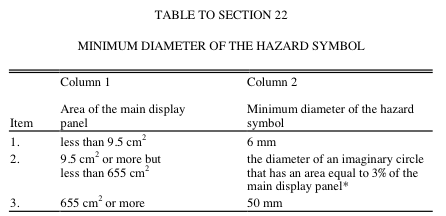
So, this is the kind of thing you only have to do twice before it's safer and easier to offload the entire calculation off to the computer.
Update: Had to escape "STDIN" with backslashes for Blogger. Remove before use.
So, this is the kind of thing you only have to do twice before it's safer and easier to offload the entire calculation off to the computer.
#! usr/bin/perl
# a formula used to calculate size of "signal word" for Cdn cautionary copy.
# Find diameter of a circle with an area equal to 3% of the PDP.
# That's how big any required symbol needs to be.
# The signal word then has to be 1/4 that size.

use Math::Complex;
use constant PI  => 4 * atan2(1, 1);
print "enter the X dimension of your PDP in centimeters\n";
my $xDim = (<\STDIN\>);
print "enter the y dimension of your PDP in centimeters\n";
my $yDim = (<\STDIN\>);
my $PDPArea = $xDim * $yDim;
my $SignalWordHeight = (sqrt(($PDPArea * .03)/PI))/2;

printf "the area of the principal display panel is %.3f cm square, and the signal word should be at least %.3f cm high.\n", $PDPArea, $SignalWordHeight;
Update: Had to escape "STDIN" with backslashes for Blogger. Remove before use.
Saturday, September 29, 2007
Visualization
In which I start out talking about decision trees, and end up talking about shelf sets.
Matt Neuburg has an interesting writeup at Tidbits of a decision making tool called Flying Logic. The program creates "intelligent" decision trees that provide visual feedback as to how to navigate the complex web of dependencies required in order to get to a goal.
Yes, you can do this with a whiteboard (or Omnigraffle), but those don't let you offload logic out of your head.
This is a tool that's probably only worth checking out for major initiatives, but more broadly, the power of visualization in aiding group decision-making can't be overstated. Without visual reference, planning meetings are essentially Socratic dialogs, which is unnecessarily hard work.
Even in the world of brand design, I am often sitting in a meeting talking about "the chosen design" and what needs to happen to it... without any visual reference. Looking around the table, you can see everyone's eyes focussing off in the middle distance as we recall what that design looked like. More unnecessarily hard work.
Think ahead about what needs to be in your library of visual reference material, and keep it at hand in your team's public discussion areas. For CPG design, this means comprehensive shelf sets, and reference for visual equity elements and physical materials. Don't have your meetings in conference rooms, you'll just have to bring your stuff there, and that's too much work, so you won't.
Tuesday, September 25, 2007

Sunday, September 23, 2007
About a certain type of article which seems to be typical of the New Yorker
Simulacra in the high culture bazaar.... (via BoingBoing)
There was an interesting article by James Surowiecki in the New Yorker this week about fashion design knockoffs, and the unacknowledged link in the chain of commerce which they play:
The paradox stems from the basic dilemma that underpins the economics of fashion: for the industry to keep growing, customers must like this year’s designs, but they must also become dissatisfied with them, so that they’ll buy next year’s.
It seems the real depends upon the simulacra in order to exist, or at least to have value.
There have been many other articles about the phenomenon of the simulacra over the past few years in the New Yorker. Here's a few off the top of my head:
- Calvin Trillin's claim that white wine served at room temperature tastes just like red wine if you close your eyes (I think Cal should stick to food writing).
- The story I blogged earlier about Argentinian sunflower-seed oil etc. being labeled as extra-virgin Italian olive oil.
- Last week's incredible story about Joyce Hatto, the greatest pianist who never was, and her Svengali-like husband, who assembled hundreds of Joyce Hatto CDs out of bits and bobs of other recordings, and turned her into a star, until the hoax was discovered. I liked the bit at the beginning about the cottage industry of recordings issued under false names.
- The story the week before that about the hard-working counterfeiter of bottles of wine reputed to have belonged to Thomas Jefferson, which sold to collectors for hundreds of thousands of dollars. Robert Parker was a fan.
Each of these articles takes as their subject a culturally freighted pleasure which forms one of the cornerstones of their target demographic's highbrow, luxury lifestyle: gourmet food, wine auctions, classical music, haute couture. In each case, received wisdom about the hierarchy of the Good is tested: blindfolded, could you tell white wine from red? How can critics praise the same recordings when attributed to Joyce Hatto which they dismissed when presented under their true performer's name? If a blind stranger came to dinner and you served him dog food, how much trouble would you be in when he turned out to be Wotan?
I guess part of what this supports is the idea that with the New Yorker you get the unvarnished truth, including cultural metacriticism.
So what is clearly needed to complete these categories of counterfeitings is a story about a literary fiction. It's surprising the Raymond Carver - Gordon Lish authorship dispute never made it to their pages.
But yes: in this aisle of culture, the New Yorker is a producer, not a critic.
Friday, September 14, 2007
More cocoa image editors
Iris, another Cocoa pixel graphics editor coming on line with Leopard. From the makers of Interarchy. No beta until Leopard ships. No idea what that will look like.
And Line Form, a Cocoa vector graphics editor which lets you apply Core Image filters nondestructively to any vector or raster object. Sort of like what Illustrator CS3 would be if it were rewritten from scratch, just for Mac OS X. It's fun.
And Line Form, a Cocoa vector graphics editor which lets you apply Core Image filters nondestructively to any vector or raster object. Sort of like what Illustrator CS3 would be if it were rewritten from scratch, just for Mac OS X. It's fun.
Monday, September 10, 2007
More Acorny goodness
There's a buried plist entry in Acorn to turn on the "Save a copy" menu item... which is as close to "Export for Web" as we get for now.
defaults write com.flyingmeat.Acorn saveACopyMenuItem 1Thanks, Gus, and I'll be sure to let everyone know this is unsupported ;)
Vs. the 800 lb Gorilla.
Acorn looks like an awesome little image editor, and it comes from Gus Mueller, the author of VoodooPad, so it's automatically worth downloading to check out.
Core Image effects, Python scripting, small footprint... looks like it leverages a lot of Mac goodness. I admire the move away from the paletted UI, but the combination of "tools" and "layers" into one palette might take a bit of getting used to. Many years of Photoshop make me want to break the tools off and put it on the far left, and put the rest of the palette on the far right.
But this is just the thing if you want to keep something around that starts up more quickly than Photoshop, especially if, like me, you're still working with a pre-Universal Binary version of Photoshop, which I never want to keep open for fear of Rosetta gobbling up all my RAM.
Core Image effects, Python scripting, small footprint... looks like it leverages a lot of Mac goodness. I admire the move away from the paletted UI, but the combination of "tools" and "layers" into one palette might take a bit of getting used to. Many years of Photoshop make me want to break the tools off and put it on the far left, and put the rest of the palette on the far right.
But this is just the thing if you want to keep something around that starts up more quickly than Photoshop, especially if, like me, you're still working with a pre-Universal Binary version of Photoshop, which I never want to keep open for fear of Rosetta gobbling up all my RAM.
Sunday, September 09, 2007
handy mac key modifier
Next time you're hitting the backspace key to delete some words, hold down the option key while you're doing it.
It makes not holding the option key down feel incredibly stupid.
It makes not holding the option key down feel incredibly stupid.
Scutching

My wife's family uses the verb scutch exclusively to mean "to enjoin," as in "Mom was scutching me to get my homework done before dinner." Sort of like the evidently related heckle, but with the object of improving the person whom you are addressing. It was just one of those family words.
Then I came across a brochure for an old-timey "Flax Scutching Festival" in Pennsylvania, and the etymological mystery was solved. The root, physical meaning is to beat stalks of flax to obtain fibers which can be made into linen. The metaphorical meaning is thus, to abuse, with the intention of a practical improvement to the abused object...
Above are two images from the brochure, illustrating scutching, and also the root, physical meaning of "to heckle," which looks painful too.
So many words have drifted this way, concrete meanings suggesting metaphorical ones, until in time the metaphorical meaning obliterates the concrete one. Few English speakers make flax into linen any more, but many have the experience of bothering someone to their betterment, or of being so bothered.
As far as I know, this is an undocumented usage of the word, and I do not know of anyone outside my wife's family who uses the word this way. I would appreciate feedback if you have also heard this usage.
Friday, September 07, 2007
Yes

It's really true about surgery these days; everyone shows up asking you for your full name and birth date, and why you're here today, and which knee it is that they're going to operate on.
And someone really did inscribe the word "yes" on me, like a charm, to affirm to all who could see that I was going to get arthroscopic surgery on my left knee. Without seeing the charm, the surgeon cannot make the cut.
Tuesday, September 04, 2007
"I'm only into their old stuff"
To Dolan's list of rock n' roll bands that got better over time, counter to the prevailing Romantic idea equating quality with origin-ality, I was going to add Pavement. I remember selling Westing (by musket and sextant) back to that snooty CD shop in Iowa City because it just seemed like the noisy flailings of a bunch of smart-ass kids who had recently encountered some musical instruments. They exhibited that sense that they knew they had genius in them because they could feel it oozing out of their pores.
Almost a decade on, after everyone else was done with them, I caught up with the later Brighten the Corners, and thought it was fantastic.
So when the deluxe 2 CD edition of Slanted & Enchanted came out in 2002, I eagerly put down my $18.99 for an actual hard copy, but when I put it on I could not get past track 5. Back on the rack it went, for years. Once in a while I would get it out just to admire the deluxe should-have-been-there booklet, tucked along with the CD into a slipcase which ran an emboss over the original artwork's brushstroked title.
But just the other day I finally ripped both CDs to iTunes and put it on the iPod, and listened to both disks straight through several times in a row. It's a beautiful mess.
Almost a decade on, after everyone else was done with them, I caught up with the later Brighten the Corners, and thought it was fantastic.
So when the deluxe 2 CD edition of Slanted & Enchanted came out in 2002, I eagerly put down my $18.99 for an actual hard copy, but when I put it on I could not get past track 5. Back on the rack it went, for years. Once in a while I would get it out just to admire the deluxe should-have-been-there booklet, tucked along with the CD into a slipcase which ran an emboss over the original artwork's brushstroked title.
But just the other day I finally ripped both CDs to iTunes and put it on the iPod, and listened to both disks straight through several times in a row. It's a beautiful mess.
Subscribe to:
Posts (Atom)

